Why H-2B Applications Get Denied (And How to Avoid It)
Published by PinesH2B Solutions | H-2B Business Consultation & Recruitment

April 11, 2026
Most H-2B denials aren't random. They come from the same preventable mistakes, documentation errors, timing problems, and filings that don't hold up under review. If your case gets denied or hits a Notice of Deficiency, there's almost always a specific reason. This is where those reasons live.
This is how the H-2B denial process actually works across DOL, USCIS, and consular review, not just how it's described in the instructions.
What Causes H-2B Applications to Be Denied?
The H-2B process runs through multiple federal agencies, and each one has its own standards. DOL is looking at whether you've established a genuine temporary need and completed recruitment correctly. USCIS is checking whether the petition matches the certification. Consular officers are reviewing individual workers.
A denial at any stage can end your hiring cycle. The cases that survive are the ones that were built correctly from the start, not patched together after a deficiency notice arrived.
What Are the Most Common H-2B Denial Reasons?
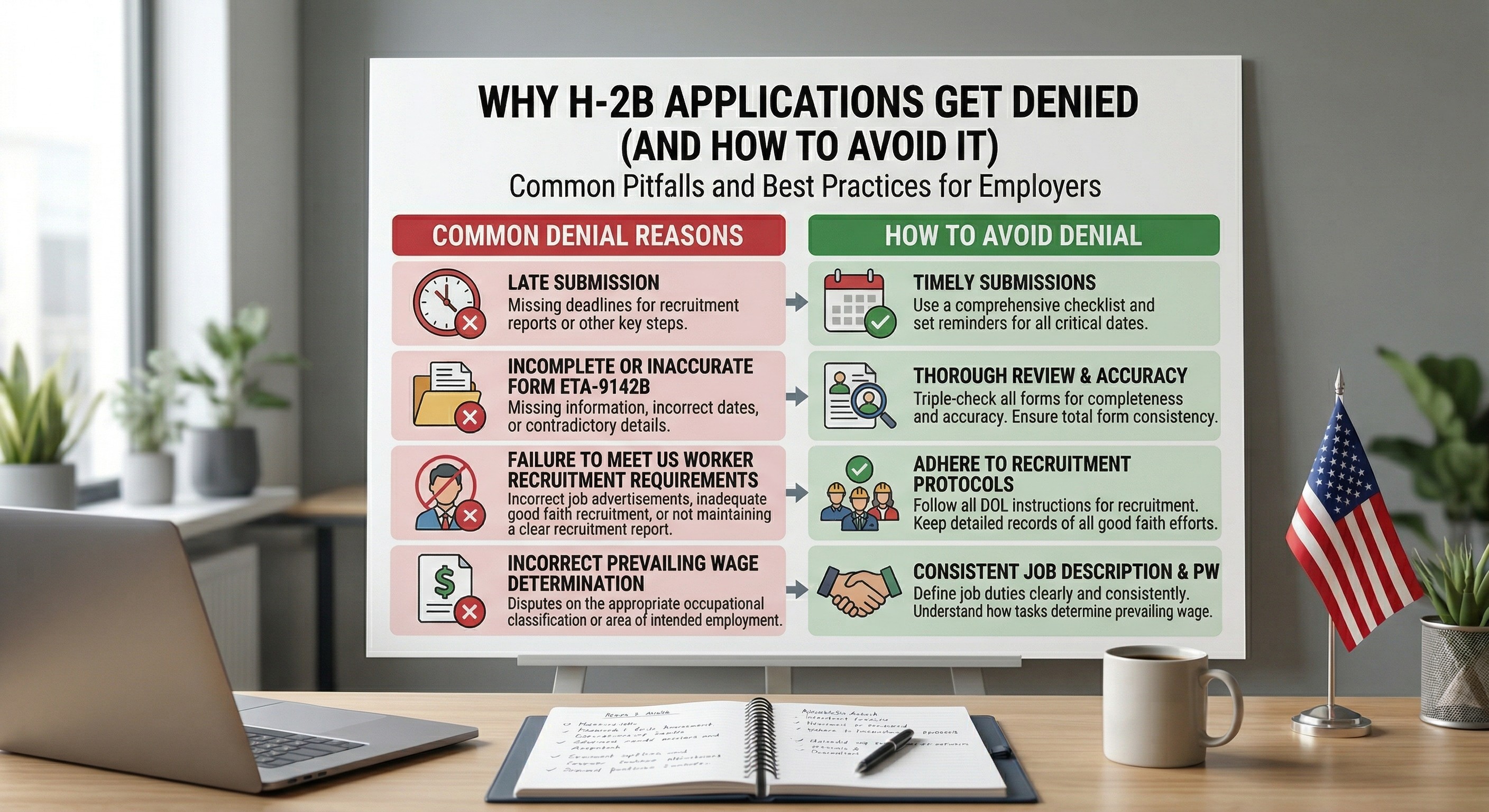
Weak temporary need statement: This is the single most common reason H-2B applications run into trouble at the DOL stage. Your temporary need statement has to actually make the case, specific dates, specific business reasons, and specific documentation of why the need is temporary and not permanent. Writing "See Attached" or submitting a vague one-paragraph explanation is not enough. DOL reviewers flag this fast, and a Notice of Deficiency on temporary need can require a full rewrite and refile.
Documentation errors: Missing original wet signatures on Appendix B. Certified translations are absent from non-English recruitment contracts. Inconsistent dates between documents. Any one of these can stop a case. Combined, they usually do. These aren't obscure requirements; they're in the instructions. But they're easy to miss when you're assembling a filing under pressure.
Recruitment mistakes: The H-2B process requires a specific recruitment sequence before you can file. The Recruitment Report has to be submitted after the job has been posted for 15 consecutive business days following the Notice of Acceptance, not before. File it one day early, and it gets rejected. That's a refile and lost time you don't get back during a competitive filing window.
Inconsistent filings: The Job Order submitted to the State Workforce Agency and the H-2B application filed with DOL have to match exactly. Worker counts, dates of need, and worksite locations, if any of those differ between the two filings, the case stalls. This happens more than it should, usually because different people handled different parts of the filing without coordinating.
Missing required steps: Some states require out-of-state employers to register with the SWA before they can use the portal at all. If that registration isn't in place when you try to file, you lose time before the case even starts. Unanticipated worksites that aren't supported by the underlying Prevailing Wage Determination cause the same problem, a gap in the foundation that creates a deficiency later.
What Triggers a Notice of Deficiency in the H-2B Process?
A Notice of Deficiency (NOD) is DOL's way of telling you something is wrong before they issue a formal denial. It sounds better than a denial, and it is, but it still costs time, and time in the H-2B process is not recoverable.
The most common NOD triggers:
Temporary need language that's too vague or unsupported
"See Attached" is used as a substitute for an actual statement
Appendix B is missing an original wet signature or was signed on the wrong date
A registration number was manually pasted into the FLAG system instead of being linked properly (this one surprises people; DOL will send a deficiency asking you to remove it)
Recruitment Report submitted before the 15-day posting period is complete
Job Order details that don't match the H-2B application
Getting a NOD isn't automatic death for the case, but responding to one correctly takes time, and if you're already close to the cap or the filing window, that time may not exist.
Where Do Employers Go Wrong in the H-2B Process?
Filing at the wrong time: For winter hiring, the TLC filing window opens July 1–3. Cases filed in that window are randomized into processing groups. Cases filed outside it don't get the same treatment. Employers who miss the window, or who file before all their documents are ready, create problems that are hard to fix mid-process.
Mismatch between SWA and DOL filings: The Job Order and the H-2B application are separate filings submitted to separate agencies, and they have to say the same thing. Employers who treat them as separate tasks instead of a coordinated package end up with inconsistencies that flag during review.
Rushing documents: The pressure of a competitive filing window causes employers to submit before they're actually ready. A missing signature or an incomplete temporary need statement gets filed because someone assumed it was close enough. It's usually not. DOL reviewers aren't looking for close enough.
Relying on last year's filing as a template without updating it: Dates change. Worksites change. Worker counts change. Using a prior year's filing without carefully updating every field is a reliable way to create a mismatch that triggers a deficiency.
How Do You Avoid H-2B Denial?
Preparation: Start the H-2B process in spring for a winter start date. The prevailing wage determination alone should be filed at least 60 days before you need it. If you're starting to think about this in June, you're already reacting instead of planning.
Consistency: Every document in the filing has to tell the same story. The same dates, the same worker count, the same worksite. Build a checklist and verify every field across every form before anything gets submitted.
Timing: Know the 15-day posting requirement cold. Know when your Notice of Acceptance arrives and count the business days from there. The Recruitment Report goes in after that window closes, not when it looks like it's probably been long enough.
Documentation: Original wet signatures. Certified translations were required. A temporary need statement that actually explains the need in specific, verifiable terms. These aren't formalities; they're the substance of the filing.
What Happens If Your H-2B Application Is Denied?
A denial is not always the end, but your options depend on where in the process it happened and how much time is left in the cycle.
Refile if time allows: If the denial came from a correctable error and the filing window is still open, or if the cap hasn't been reached, you may be able to address the issue and refile. This requires understanding exactly what the denial was based on, not just fixing what seems wrong.
Adjust and reapply for the next cycle: If the filing window has closed or the cap has been reached, the current cycle is likely done. The focus shifts to understanding what went wrong, fixing it, and making sure the next filing is correct from the start.
Timing impact: A denied H-2B application doesn't just affect this season. If it came from a systemic issue in how the case was built, weak temporary need language, or a pattern of documentation errors, those issues will repeat unless they're addressed. The H-2B process rewards consistency over time.
Your H-2B Case Needs to Be Right the First Time
Denials and deficiency notices don't just cost you the filing fee. They cost you time in a process where time is the one thing you can't get back.
Submit your details below, and we'll review your H-2B case based on your target start date.
We'll respond within one business day.
Most H-2B denials aren't random. They come from the same preventable mistakes, documentation errors, timing problems, and filings that don't hold up under review. If your case gets denied or hits a Notice of Deficiency, there's almost always a specific reason. This is where those reasons live.
This is how the H-2B denial process actually works across DOL, USCIS, and consular review, not just how it's described in the instructions.
What Causes H-2B Applications to Be Denied?
The H-2B process runs through multiple federal agencies, and each one has its own standards. DOL is looking at whether you've established a genuine temporary need and completed recruitment correctly. USCIS is checking whether the petition matches the certification. Consular officers are reviewing individual workers.
A denial at any stage can end your hiring cycle. The cases that survive are the ones that were built correctly from the start, not patched together after a deficiency notice arrived.
What Are the Most Common H-2B Denial Reasons?
Weak temporary need statement: This is the single most common reason H-2B applications run into trouble at the DOL stage. Your temporary need statement has to actually make the case, specific dates, specific business reasons, and specific documentation of why the need is temporary and not permanent. Writing "See Attached" or submitting a vague one-paragraph explanation is not enough. DOL reviewers flag this fast, and a Notice of Deficiency on temporary need can require a full rewrite and refile.
Documentation errors: Missing original wet signatures on Appendix B. Certified translations are absent from non-English recruitment contracts. Inconsistent dates between documents. Any one of these can stop a case. Combined, they usually do. These aren't obscure requirements; they're in the instructions. But they're easy to miss when you're assembling a filing under pressure.
Recruitment mistakes: The H-2B process requires a specific recruitment sequence before you can file. The Recruitment Report has to be submitted after the job has been posted for 15 consecutive business days following the Notice of Acceptance, not before. File it one day early, and it gets rejected. That's a refile and lost time you don't get back during a competitive filing window.
Inconsistent filings: The Job Order submitted to the State Workforce Agency and the H-2B application filed with DOL have to match exactly. Worker counts, dates of need, and worksite locations, if any of those differ between the two filings, the case stalls. This happens more than it should, usually because different people handled different parts of the filing without coordinating.
Missing required steps: Some states require out-of-state employers to register with the SWA before they can use the portal at all. If that registration isn't in place when you try to file, you lose time before the case even starts. Unanticipated worksites that aren't supported by the underlying Prevailing Wage Determination cause the same problem, a gap in the foundation that creates a deficiency later.
What Triggers a Notice of Deficiency in the H-2B Process?
A Notice of Deficiency (NOD) is DOL's way of telling you something is wrong before they issue a formal denial. It sounds better than a denial, and it is, but it still costs time, and time in the H-2B process is not recoverable.
The most common NOD triggers:
Temporary need language that's too vague or unsupported
"See Attached" is used as a substitute for an actual statement
Appendix B is missing an original wet signature or was signed on the wrong date
A registration number was manually pasted into the FLAG system instead of being linked properly (this one surprises people; DOL will send a deficiency asking you to remove it)
Recruitment Report submitted before the 15-day posting period is complete
Job Order details that don't match the H-2B application
Getting a NOD isn't automatic death for the case, but responding to one correctly takes time, and if you're already close to the cap or the filing window, that time may not exist.
Where Do Employers Go Wrong in the H-2B Process?
Filing at the wrong time: For winter hiring, the TLC filing window opens July 1–3. Cases filed in that window are randomized into processing groups. Cases filed outside it don't get the same treatment. Employers who miss the window, or who file before all their documents are ready, create problems that are hard to fix mid-process.
Mismatch between SWA and DOL filings: The Job Order and the H-2B application are separate filings submitted to separate agencies, and they have to say the same thing. Employers who treat them as separate tasks instead of a coordinated package end up with inconsistencies that flag during review.
Rushing documents: The pressure of a competitive filing window causes employers to submit before they're actually ready. A missing signature or an incomplete temporary need statement gets filed because someone assumed it was close enough. It's usually not. DOL reviewers aren't looking for close enough.
Relying on last year's filing as a template without updating it: Dates change. Worksites change. Worker counts change. Using a prior year's filing without carefully updating every field is a reliable way to create a mismatch that triggers a deficiency.
How Do You Avoid H-2B Denial?
Preparation: Start the H-2B process in spring for a winter start date. The prevailing wage determination alone should be filed at least 60 days before you need it. If you're starting to think about this in June, you're already reacting instead of planning.
Consistency: Every document in the filing has to tell the same story. The same dates, the same worker count, the same worksite. Build a checklist and verify every field across every form before anything gets submitted.
Timing: Know the 15-day posting requirement cold. Know when your Notice of Acceptance arrives and count the business days from there. The Recruitment Report goes in after that window closes, not when it looks like it's probably been long enough.
Documentation: Original wet signatures. Certified translations were required. A temporary need statement that actually explains the need in specific, verifiable terms. These aren't formalities; they're the substance of the filing.
What Happens If Your H-2B Application Is Denied?
A denial is not always the end, but your options depend on where in the process it happened and how much time is left in the cycle.
Refile if time allows: If the denial came from a correctable error and the filing window is still open, or if the cap hasn't been reached, you may be able to address the issue and refile. This requires understanding exactly what the denial was based on, not just fixing what seems wrong.
Adjust and reapply for the next cycle: If the filing window has closed or the cap has been reached, the current cycle is likely done. The focus shifts to understanding what went wrong, fixing it, and making sure the next filing is correct from the start.
Timing impact: A denied H-2B application doesn't just affect this season. If it came from a systemic issue in how the case was built, weak temporary need language, or a pattern of documentation errors, those issues will repeat unless they're addressed. The H-2B process rewards consistency over time.
Your H-2B Case Needs to Be Right the First Time
Denials and deficiency notices don't just cost you the filing fee. They cost you time in a process where time is the one thing you can't get back.
Submit your details below, and we'll review your H-2B case based on your target start date.
We'll respond within one business day.
Most H-2B denials aren't random. They come from the same preventable mistakes, documentation errors, timing problems, and filings that don't hold up under review. If your case gets denied or hits a Notice of Deficiency, there's almost always a specific reason. This is where those reasons live.
This is how the H-2B denial process actually works across DOL, USCIS, and consular review, not just how it's described in the instructions.
What Causes H-2B Applications to Be Denied?
The H-2B process runs through multiple federal agencies, and each one has its own standards. DOL is looking at whether you've established a genuine temporary need and completed recruitment correctly. USCIS is checking whether the petition matches the certification. Consular officers are reviewing individual workers.
A denial at any stage can end your hiring cycle. The cases that survive are the ones that were built correctly from the start, not patched together after a deficiency notice arrived.
What Are the Most Common H-2B Denial Reasons?
Weak temporary need statement: This is the single most common reason H-2B applications run into trouble at the DOL stage. Your temporary need statement has to actually make the case, specific dates, specific business reasons, and specific documentation of why the need is temporary and not permanent. Writing "See Attached" or submitting a vague one-paragraph explanation is not enough. DOL reviewers flag this fast, and a Notice of Deficiency on temporary need can require a full rewrite and refile.
Documentation errors: Missing original wet signatures on Appendix B. Certified translations are absent from non-English recruitment contracts. Inconsistent dates between documents. Any one of these can stop a case. Combined, they usually do. These aren't obscure requirements; they're in the instructions. But they're easy to miss when you're assembling a filing under pressure.
Recruitment mistakes: The H-2B process requires a specific recruitment sequence before you can file. The Recruitment Report has to be submitted after the job has been posted for 15 consecutive business days following the Notice of Acceptance, not before. File it one day early, and it gets rejected. That's a refile and lost time you don't get back during a competitive filing window.
Inconsistent filings: The Job Order submitted to the State Workforce Agency and the H-2B application filed with DOL have to match exactly. Worker counts, dates of need, and worksite locations, if any of those differ between the two filings, the case stalls. This happens more than it should, usually because different people handled different parts of the filing without coordinating.
Missing required steps: Some states require out-of-state employers to register with the SWA before they can use the portal at all. If that registration isn't in place when you try to file, you lose time before the case even starts. Unanticipated worksites that aren't supported by the underlying Prevailing Wage Determination cause the same problem, a gap in the foundation that creates a deficiency later.
What Triggers a Notice of Deficiency in the H-2B Process?
A Notice of Deficiency (NOD) is DOL's way of telling you something is wrong before they issue a formal denial. It sounds better than a denial, and it is, but it still costs time, and time in the H-2B process is not recoverable.
The most common NOD triggers:
Temporary need language that's too vague or unsupported
"See Attached" is used as a substitute for an actual statement
Appendix B is missing an original wet signature or was signed on the wrong date
A registration number was manually pasted into the FLAG system instead of being linked properly (this one surprises people; DOL will send a deficiency asking you to remove it)
Recruitment Report submitted before the 15-day posting period is complete
Job Order details that don't match the H-2B application
Getting a NOD isn't automatic death for the case, but responding to one correctly takes time, and if you're already close to the cap or the filing window, that time may not exist.
Where Do Employers Go Wrong in the H-2B Process?
Filing at the wrong time: For winter hiring, the TLC filing window opens July 1–3. Cases filed in that window are randomized into processing groups. Cases filed outside it don't get the same treatment. Employers who miss the window, or who file before all their documents are ready, create problems that are hard to fix mid-process.
Mismatch between SWA and DOL filings: The Job Order and the H-2B application are separate filings submitted to separate agencies, and they have to say the same thing. Employers who treat them as separate tasks instead of a coordinated package end up with inconsistencies that flag during review.
Rushing documents: The pressure of a competitive filing window causes employers to submit before they're actually ready. A missing signature or an incomplete temporary need statement gets filed because someone assumed it was close enough. It's usually not. DOL reviewers aren't looking for close enough.
Relying on last year's filing as a template without updating it: Dates change. Worksites change. Worker counts change. Using a prior year's filing without carefully updating every field is a reliable way to create a mismatch that triggers a deficiency.
How Do You Avoid H-2B Denial?
Preparation: Start the H-2B process in spring for a winter start date. The prevailing wage determination alone should be filed at least 60 days before you need it. If you're starting to think about this in June, you're already reacting instead of planning.
Consistency: Every document in the filing has to tell the same story. The same dates, the same worker count, the same worksite. Build a checklist and verify every field across every form before anything gets submitted.
Timing: Know the 15-day posting requirement cold. Know when your Notice of Acceptance arrives and count the business days from there. The Recruitment Report goes in after that window closes, not when it looks like it's probably been long enough.
Documentation: Original wet signatures. Certified translations were required. A temporary need statement that actually explains the need in specific, verifiable terms. These aren't formalities; they're the substance of the filing.
What Happens If Your H-2B Application Is Denied?
A denial is not always the end, but your options depend on where in the process it happened and how much time is left in the cycle.
Refile if time allows: If the denial came from a correctable error and the filing window is still open, or if the cap hasn't been reached, you may be able to address the issue and refile. This requires understanding exactly what the denial was based on, not just fixing what seems wrong.
Adjust and reapply for the next cycle: If the filing window has closed or the cap has been reached, the current cycle is likely done. The focus shifts to understanding what went wrong, fixing it, and making sure the next filing is correct from the start.
Timing impact: A denied H-2B application doesn't just affect this season. If it came from a systemic issue in how the case was built, weak temporary need language, or a pattern of documentation errors, those issues will repeat unless they're addressed. The H-2B process rewards consistency over time.
Your H-2B Case Needs to Be Right the First Time
Denials and deficiency notices don't just cost you the filing fee. They cost you time in a process where time is the one thing you can't get back.
Submit your details below, and we'll review your H-2B case based on your target start date.
[Fill Out Our Contact Form →]
We'll respond within one business day.
Most H-2B denials aren't random. They come from the same preventable mistakes, documentation errors, timing problems, and filings that don't hold up under review. If your case gets denied or hits a Notice of Deficiency, there's almost always a specific reason. This is where those reasons live.
This is how the H-2B denial process actually works across DOL, USCIS, and consular review, not just how it's described in the instructions.
What Causes H-2B Applications to Be Denied?
The H-2B process runs through multiple federal agencies, and each one has its own standards. DOL is looking at whether you've established a genuine temporary need and completed recruitment correctly. USCIS is checking whether the petition matches the certification. Consular officers are reviewing individual workers.
A denial at any stage can end your hiring cycle. The cases that survive are the ones that were built correctly from the start, not patched together after a deficiency notice arrived.
What Are the Most Common H-2B Denial Reasons?
Weak temporary need statement: This is the single most common reason H-2B applications run into trouble at the DOL stage. Your temporary need statement has to actually make the case, specific dates, specific business reasons, and specific documentation of why the need is temporary and not permanent. Writing "See Attached" or submitting a vague one-paragraph explanation is not enough. DOL reviewers flag this fast, and a Notice of Deficiency on temporary need can require a full rewrite and refile.
Documentation errors: Missing original wet signatures on Appendix B. Certified translations are absent from non-English recruitment contracts. Inconsistent dates between documents. Any one of these can stop a case. Combined, they usually do. These aren't obscure requirements; they're in the instructions. But they're easy to miss when you're assembling a filing under pressure.
Recruitment mistakes: The H-2B process requires a specific recruitment sequence before you can file. The Recruitment Report has to be submitted after the job has been posted for 15 consecutive business days following the Notice of Acceptance, not before. File it one day early, and it gets rejected. That's a refile and lost time you don't get back during a competitive filing window.
Inconsistent filings: The Job Order submitted to the State Workforce Agency and the H-2B application filed with DOL have to match exactly. Worker counts, dates of need, and worksite locations, if any of those differ between the two filings, the case stalls. This happens more than it should, usually because different people handled different parts of the filing without coordinating.
Missing required steps: Some states require out-of-state employers to register with the SWA before they can use the portal at all. If that registration isn't in place when you try to file, you lose time before the case even starts. Unanticipated worksites that aren't supported by the underlying Prevailing Wage Determination cause the same problem, a gap in the foundation that creates a deficiency later.
What Triggers a Notice of Deficiency in the H-2B Process?
A Notice of Deficiency (NOD) is DOL's way of telling you something is wrong before they issue a formal denial. It sounds better than a denial, and it is, but it still costs time, and time in the H-2B process is not recoverable.
The most common NOD triggers:
Temporary need language that's too vague or unsupported
"See Attached" is used as a substitute for an actual statement
Appendix B is missing an original wet signature or was signed on the wrong date
A registration number was manually pasted into the FLAG system instead of being linked properly (this one surprises people; DOL will send a deficiency asking you to remove it)
Recruitment Report submitted before the 15-day posting period is complete
Job Order details that don't match the H-2B application
Getting a NOD isn't automatic death for the case, but responding to one correctly takes time, and if you're already close to the cap or the filing window, that time may not exist.
Where Do Employers Go Wrong in the H-2B Process?
Filing at the wrong time: For winter hiring, the TLC filing window opens July 1–3. Cases filed in that window are randomized into processing groups. Cases filed outside it don't get the same treatment. Employers who miss the window, or who file before all their documents are ready, create problems that are hard to fix mid-process.
Mismatch between SWA and DOL filings: The Job Order and the H-2B application are separate filings submitted to separate agencies, and they have to say the same thing. Employers who treat them as separate tasks instead of a coordinated package end up with inconsistencies that flag during review.
Rushing documents: The pressure of a competitive filing window causes employers to submit before they're actually ready. A missing signature or an incomplete temporary need statement gets filed because someone assumed it was close enough. It's usually not. DOL reviewers aren't looking for close enough.
Relying on last year's filing as a template without updating it: Dates change. Worksites change. Worker counts change. Using a prior year's filing without carefully updating every field is a reliable way to create a mismatch that triggers a deficiency.
How Do You Avoid H-2B Denial?
Preparation: Start the H-2B process in spring for a winter start date. The prevailing wage determination alone should be filed at least 60 days before you need it. If you're starting to think about this in June, you're already reacting instead of planning.
Consistency: Every document in the filing has to tell the same story. The same dates, the same worker count, the same worksite. Build a checklist and verify every field across every form before anything gets submitted.
Timing: Know the 15-day posting requirement cold. Know when your Notice of Acceptance arrives and count the business days from there. The Recruitment Report goes in after that window closes, not when it looks like it's probably been long enough.
Documentation: Original wet signatures. Certified translations were required. A temporary need statement that actually explains the need in specific, verifiable terms. These aren't formalities; they're the substance of the filing.
What Happens If Your H-2B Application Is Denied?
A denial is not always the end, but your options depend on where in the process it happened and how much time is left in the cycle.
Refile if time allows: If the denial came from a correctable error and the filing window is still open, or if the cap hasn't been reached, you may be able to address the issue and refile. This requires understanding exactly what the denial was based on, not just fixing what seems wrong.
Adjust and reapply for the next cycle: If the filing window has closed or the cap has been reached, the current cycle is likely done. The focus shifts to understanding what went wrong, fixing it, and making sure the next filing is correct from the start.
Timing impact: A denied H-2B application doesn't just affect this season. If it came from a systemic issue in how the case was built, weak temporary need language, or a pattern of documentation errors, those issues will repeat unless they're addressed. The H-2B process rewards consistency over time.
Your H-2B Case Needs to Be Right the First Time
Denials and deficiency notices don't just cost you the filing fee. They cost you time in a process where time is the one thing you can't get back.
Submit your details below, and we'll review your H-2B case based on your target start date.
[Fill Out Our Contact Form →]
We'll respond within one business day.
Most H-2B denials aren't random. They come from the same preventable mistakes, documentation errors, timing problems, and filings that don't hold up under review. If your case gets denied or hits a Notice of Deficiency, there's almost always a specific reason. This is where those reasons live.
This is how the H-2B denial process actually works across DOL, USCIS, and consular review, not just how it's described in the instructions.
What Causes H-2B Applications to Be Denied?
The H-2B process runs through multiple federal agencies, and each one has its own standards. DOL is looking at whether you've established a genuine temporary need and completed recruitment correctly. USCIS is checking whether the petition matches the certification. Consular officers are reviewing individual workers.
A denial at any stage can end your hiring cycle. The cases that survive are the ones that were built correctly from the start, not patched together after a deficiency notice arrived.
What Are the Most Common H-2B Denial Reasons?
Weak temporary need statement: This is the single most common reason H-2B applications run into trouble at the DOL stage. Your temporary need statement has to actually make the case, specific dates, specific business reasons, and specific documentation of why the need is temporary and not permanent. Writing "See Attached" or submitting a vague one-paragraph explanation is not enough. DOL reviewers flag this fast, and a Notice of Deficiency on temporary need can require a full rewrite and refile.
Documentation errors: Missing original wet signatures on Appendix B. Certified translations are absent from non-English recruitment contracts. Inconsistent dates between documents. Any one of these can stop a case. Combined, they usually do. These aren't obscure requirements; they're in the instructions. But they're easy to miss when you're assembling a filing under pressure.
Recruitment mistakes: The H-2B process requires a specific recruitment sequence before you can file. The Recruitment Report has to be submitted after the job has been posted for 15 consecutive business days following the Notice of Acceptance, not before. File it one day early, and it gets rejected. That's a refile and lost time you don't get back during a competitive filing window.
Inconsistent filings: The Job Order submitted to the State Workforce Agency and the H-2B application filed with DOL have to match exactly. Worker counts, dates of need, and worksite locations, if any of those differ between the two filings, the case stalls. This happens more than it should, usually because different people handled different parts of the filing without coordinating.
Missing required steps: Some states require out-of-state employers to register with the SWA before they can use the portal at all. If that registration isn't in place when you try to file, you lose time before the case even starts. Unanticipated worksites that aren't supported by the underlying Prevailing Wage Determination cause the same problem, a gap in the foundation that creates a deficiency later.
What Triggers a Notice of Deficiency in the H-2B Process?
A Notice of Deficiency (NOD) is DOL's way of telling you something is wrong before they issue a formal denial. It sounds better than a denial, and it is, but it still costs time, and time in the H-2B process is not recoverable.
The most common NOD triggers:
Temporary need language that's too vague or unsupported
"See Attached" is used as a substitute for an actual statement
Appendix B is missing an original wet signature or was signed on the wrong date
A registration number was manually pasted into the FLAG system instead of being linked properly (this one surprises people; DOL will send a deficiency asking you to remove it)
Recruitment Report submitted before the 15-day posting period is complete
Job Order details that don't match the H-2B application
Getting a NOD isn't automatic death for the case, but responding to one correctly takes time, and if you're already close to the cap or the filing window, that time may not exist.
Where Do Employers Go Wrong in the H-2B Process?
Filing at the wrong time: For winter hiring, the TLC filing window opens July 1–3. Cases filed in that window are randomized into processing groups. Cases filed outside it don't get the same treatment. Employers who miss the window, or who file before all their documents are ready, create problems that are hard to fix mid-process.
Mismatch between SWA and DOL filings: The Job Order and the H-2B application are separate filings submitted to separate agencies, and they have to say the same thing. Employers who treat them as separate tasks instead of a coordinated package end up with inconsistencies that flag during review.
Rushing documents: The pressure of a competitive filing window causes employers to submit before they're actually ready. A missing signature or an incomplete temporary need statement gets filed because someone assumed it was close enough. It's usually not. DOL reviewers aren't looking for close enough.
Relying on last year's filing as a template without updating it: Dates change. Worksites change. Worker counts change. Using a prior year's filing without carefully updating every field is a reliable way to create a mismatch that triggers a deficiency.
How Do You Avoid H-2B Denial?
Preparation: Start the H-2B process in spring for a winter start date. The prevailing wage determination alone should be filed at least 60 days before you need it. If you're starting to think about this in June, you're already reacting instead of planning.
Consistency: Every document in the filing has to tell the same story. The same dates, the same worker count, the same worksite. Build a checklist and verify every field across every form before anything gets submitted.
Timing: Know the 15-day posting requirement cold. Know when your Notice of Acceptance arrives and count the business days from there. The Recruitment Report goes in after that window closes, not when it looks like it's probably been long enough.
Documentation: Original wet signatures. Certified translations were required. A temporary need statement that actually explains the need in specific, verifiable terms. These aren't formalities; they're the substance of the filing.
What Happens If Your H-2B Application Is Denied?
A denial is not always the end, but your options depend on where in the process it happened and how much time is left in the cycle.
Refile if time allows: If the denial came from a correctable error and the filing window is still open, or if the cap hasn't been reached, you may be able to address the issue and refile. This requires understanding exactly what the denial was based on, not just fixing what seems wrong.
Adjust and reapply for the next cycle: If the filing window has closed or the cap has been reached, the current cycle is likely done. The focus shifts to understanding what went wrong, fixing it, and making sure the next filing is correct from the start.
Timing impact: A denied H-2B application doesn't just affect this season. If it came from a systemic issue in how the case was built, weak temporary need language, or a pattern of documentation errors, those issues will repeat unless they're addressed. The H-2B process rewards consistency over time.
Your H-2B Case Needs to Be Right the First Time
Denials and deficiency notices don't just cost you the filing fee. They cost you time in a process where time is the one thing you can't get back.
Submit your details below, and we'll review your H-2B case based on your target start date.
We'll respond within one business day.

Don't head into winter understaffed. H-2B workers are available if you start now.
Don't head into winter understaffed. H-2B workers are available if you start now.

Explore Our Services




Recruitment Process
Outsourcing (RPO)

Attorney Network
Access
Newsletter
Join Our Newsletter
Get the latest hiring trends, staffing insights, and employer resources, delivered to your inbox.
Don't head into winter understaffed. H-2B workers are available if you start now.