H-2B Timeline for Employers: 2026 Winter Season Breakdown
Published by PinesH2B Solutions | H-2B Business Consultation & Recruitment

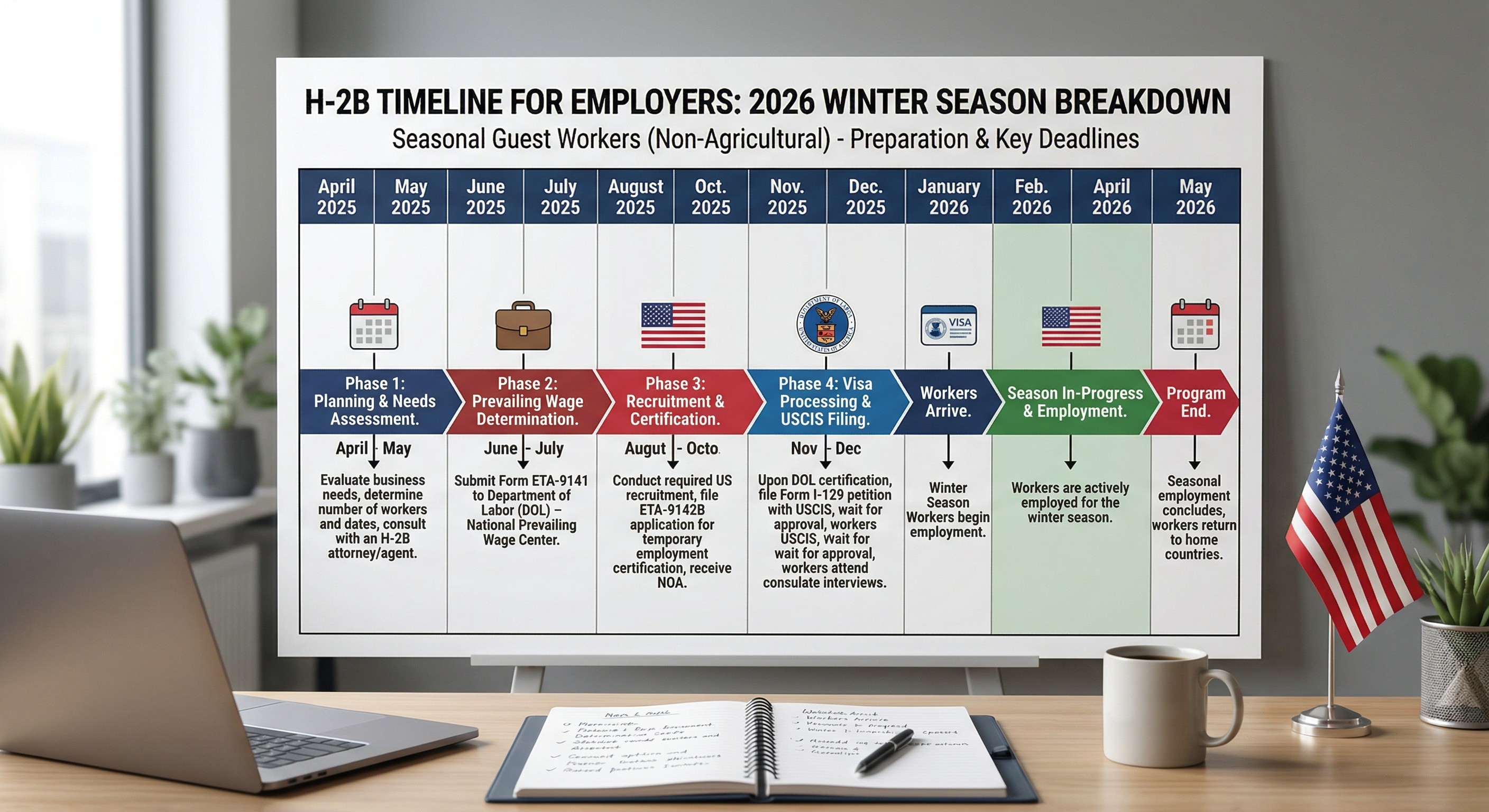
If you want H-2B workers on-site by October 1, 2026, you should have started planning in March. The H-2B process takes 6 to 7 months from first filing to worker arrival. That's not a buffer, that's the minimum. Miss the window, and you're looking at a short-staffed winter season with very few ways out.
This is how the H-2B timeline actually plays out across DOL, USCIS, and consular processing, not just how it looks on paper.
What Is the H-2B Process and How Long Does It Take?
The H-2B process is a five-stage federal filing sequence that moves through the Department of Labor, then USCIS, then a U.S. consulate abroad. For winter hiring, the full H-2B timeline runs approximately 6 to 7 months. Every stage depends on the one before it, so a delay early in the process pushes everything back.
For an October 1, 2026, start date, preparation begins in mid-March and filing happens in early July. That's not flexible; it's how the calendar works.
What Are the Steps in the H-2B Process for a Winter Start Date?
Step 1: Prevailing Wage Determination (PWD): The first step in the H-2B process is requesting a wage determination from the Department of Labor's National Prevailing Wage Center. This sets the minimum wage you're required to offer. File at least 60 days before you need it, and write job duties in plain English. Vague descriptions slow processing, and slow processing costs you weeks you don't have.
Step 2: Job Order Submission: The Job Order is your state-level job posting, filed with the State Workforce Agency (SWA) at the same time as your DOL application. Every detail in the Job Order, start dates, number of workers, and worksite location, must match your H-2B filing exactly. One mismatch can stall your entire case.
Step 3: Temporary Labor Certification (TLC): This is the core filing of the H-2B process. DOL reviews your application to confirm the temporary need and verify that hiring foreign workers won't displace U.S. workers. For an October 1, 2026, start date, the H-2B winter hiring filing window is July 1, 2, and 3, 2026. Cases filed during those three days are randomized into processing groups. You can't control which group you land in, but you can control whether you're ready.
Step 4: USCIS Petition: After DOL certifies your case, the approved TLC goes straight to USCIS. Speed here depends partly on whether the 33,000-worker winter out-of-country cap has already been reached. This is another reason the H-2B timeline rewards early preparation.
Step 5: Visa Processing and Worker Arrival: After USCIS approval, workers schedule visa appointments at a U.S. embassy or consulate. Once visas are issued, they travel and report to your worksite. That's the finish line.
What Are the Key H-2B Deadlines for Winter 2026 Hiring?
✅ Mid-March 2026 — Begin preparation
✅ July 1–3, 2026 — TLC filing window
✅ October 1, 2026 — Target start date
The H-2B winter hiring cap fills fast. In high-demand years, the out-of-country cap is reached on the first day of the filing window. If your case isn't ready to submit on July 1, you're risking your entire season.
Why Do H-2B Applications Get Delayed or Denied?
Most H-2B delays are preventable. Here's where cases commonly break down:
Documentation problems: Missing original wet signatures on Appendix B, certified translations absent from non-English recruitment contracts, or a temporary need statement that just says "See Attached" instead of actually making the case. Any of these can trigger a Notice of Deficiency (NOD) and add weeks to your H-2B timeline.
Timing mistakes: The Recruitment Report has to be submitted after the job has been posted for 15 consecutive business days following the Notice of Acceptance. File it one day early, and it gets rejected. That's a refile and more lost time.
Coordination gaps: The Job Order must be filed at the same time as the H-2B application, and every detail has to match across both filings. Mismatched worker counts, dates, or worksites are common reasons H-2B cases stall. Worksites that aren't supported by the underlying PWD are another problem we see regularly.
What Happens If You Miss the H-2B Winter Hiring Window?
Missing the July filing window, or having the cap fill before your petition is approved, means you likely won't be able to bring in new out-of-country workers for that cycle. Two fallback options exist, but neither is a clean solution.
In-country workers: Workers already in the U.S. on active H-2B status don't count against the out-of-country cap. If you can find available in-country workers, this is your fastest path forward.
Supplemental H-2B visas: DHS sometimes releases additional visas for employers who can demonstrate serious harm. For FY 2026, an additional 64,716 supplemental visas were authorized. They can help, but they come with their own conditions, their own timeline, and no guarantee. Don't build your hiring plan around them.
How Do You Avoid Delays in the H-2B Process?
A few things that make a real difference:
Register with the SWA before you need it. Some states require out-of-state employers to register before using their SWA portal. Missing this step delays the case before it even starts.
Don't manually paste registration numbers in FLAG. If a previously approved number doesn't auto-link in the system, pasting it manually can trigger a deficiency notice.
Write job duties in plain language. No internal abbreviations, no jargon, no company background that doesn't belong there.
Use original wet signatures on Appendix B. Dated consistently with the filing. This is an avoidable delay that we still see regularly.
Start the H-2B process in the spring. For winter hiring, if you're getting organized in June, you're already late.
Ready to Start Your H-2B Case for Winter 2026?
The July filing window doesn't wait. If you're targeting an October 1 start date, your case needs to be built now.
[Submit your details below and we'll map out your H-2B timeline based on your target start date →]
We'll respond within one business day.
If you want H-2B workers on-site by October 1, 2026, you should have started planning in March. The H-2B process takes 6 to 7 months from first filing to worker arrival. That's not a buffer, that's the minimum. Miss the window, and you're looking at a short-staffed winter season with very few ways out.
This is how the H-2B timeline actually plays out across DOL, USCIS, and consular processing, not just how it looks on paper.
What Is the H-2B Process and How Long Does It Take?
The H-2B process is a five-stage federal filing sequence that moves through the Department of Labor, then USCIS, then a U.S. consulate abroad. For winter hiring, the full H-2B timeline runs approximately 6 to 7 months. Every stage depends on the one before it, so a delay early in the process pushes everything back.
For an October 1, 2026, start date, preparation begins in mid-March and filing happens in early July. That's not flexible; it's how the calendar works.
What Are the Steps in the H-2B Process for a Winter Start Date?
Step 1: Prevailing Wage Determination (PWD): The first step in the H-2B process is requesting a wage determination from the Department of Labor's National Prevailing Wage Center. This sets the minimum wage you're required to offer. File at least 60 days before you need it, and write job duties in plain English. Vague descriptions slow processing, and slow processing costs you weeks you don't have.
Step 2: Job Order Submission: The Job Order is your state-level job posting, filed with the State Workforce Agency (SWA) at the same time as your DOL application. Every detail in the Job Order, start dates, number of workers, and worksite location, must match your H-2B filing exactly. One mismatch can stall your entire case.
Step 3: Temporary Labor Certification (TLC): This is the core filing of the H-2B process. DOL reviews your application to confirm the temporary need and verify that hiring foreign workers won't displace U.S. workers. For an October 1, 2026, start date, the H-2B winter hiring filing window is July 1, 2, and 3, 2026. Cases filed during those three days are randomized into processing groups. You can't control which group you land in, but you can control whether you're ready.
Step 4: USCIS Petition: After DOL certifies your case, the approved TLC goes straight to USCIS. Speed here depends partly on whether the 33,000-worker winter out-of-country cap has already been reached. This is another reason the H-2B timeline rewards early preparation.
Step 5: Visa Processing and Worker Arrival: After USCIS approval, workers schedule visa appointments at a U.S. embassy or consulate. Once visas are issued, they travel and report to your worksite. That's the finish line.
What Are the Key H-2B Deadlines for Winter 2026 Hiring?
✅ Mid-March 2026 — Begin preparation
✅ July 1–3, 2026 — TLC filing window
✅ October 1, 2026 — Target start date
The H-2B winter hiring cap fills fast. In high-demand years, the out-of-country cap is reached on the first day of the filing window. If your case isn't ready to submit on July 1, you're risking your entire season.
Why Do H-2B Applications Get Delayed or Denied?
Most H-2B delays are preventable. Here's where cases commonly break down:
Documentation problems: Missing original wet signatures on Appendix B, certified translations absent from non-English recruitment contracts, or a temporary need statement that just says "See Attached" instead of actually making the case. Any of these can trigger a Notice of Deficiency (NOD) and add weeks to your H-2B timeline.
Timing mistakes: The Recruitment Report has to be submitted after the job has been posted for 15 consecutive business days following the Notice of Acceptance. File it one day early, and it gets rejected. That's a refile and more lost time.
Coordination gaps: The Job Order must be filed at the same time as the H-2B application, and every detail has to match across both filings. Mismatched worker counts, dates, or worksites are common reasons H-2B cases stall. Worksites that aren't supported by the underlying PWD are another problem we see regularly.
What Happens If You Miss the H-2B Winter Hiring Window?
Missing the July filing window, or having the cap fill before your petition is approved, means you likely won't be able to bring in new out-of-country workers for that cycle. Two fallback options exist, but neither is a clean solution.
In-country workers: Workers already in the U.S. on active H-2B status don't count against the out-of-country cap. If you can find available in-country workers, this is your fastest path forward.
Supplemental H-2B visas: DHS sometimes releases additional visas for employers who can demonstrate serious harm. For FY 2026, an additional 64,716 supplemental visas were authorized. They can help, but they come with their own conditions, their own timeline, and no guarantee. Don't build your hiring plan around them.
How Do You Avoid Delays in the H-2B Process?
A few things that make a real difference:
Register with the SWA before you need it. Some states require out-of-state employers to register before using their SWA portal. Missing this step delays the case before it even starts.
Don't manually paste registration numbers in FLAG. If a previously approved number doesn't auto-link in the system, pasting it manually can trigger a deficiency notice.
Write job duties in plain language. No internal abbreviations, no jargon, no company background that doesn't belong there.
Use original wet signatures on Appendix B. Dated consistently with the filing. This is an avoidable delay that we still see regularly.
Start the H-2B process in the spring. For winter hiring, if you're getting organized in June, you're already late.
Ready to Start Your H-2B Case for Winter 2026?
The July filing window doesn't wait. If you're targeting an October 1 start date, your case needs to be built now.
[Submit your details below and we'll map out your H-2B timeline based on your target start date →]
We'll respond within one business day.
If you want H-2B workers on-site by October 1, 2026, you should have started planning in March. The H-2B process takes 6 to 7 months from first filing to worker arrival. That's not a buffer, that's the minimum. Miss the window, and you're looking at a short-staffed winter season with very few ways out.
This is how the H-2B timeline actually plays out across DOL, USCIS, and consular processing, not just how it looks on paper.
What Is the H-2B Process and How Long Does It Take?
The H-2B process is a five-stage federal filing sequence that moves through the Department of Labor, then USCIS, then a U.S. consulate abroad. For winter hiring, the full H-2B timeline runs approximately 6 to 7 months. Every stage depends on the one before it, so a delay early in the process pushes everything back.
For an October 1, 2026, start date, preparation begins in mid-March and filing happens in early July. That's not flexible; it's how the calendar works.
What Are the Steps in the H-2B Process for a Winter Start Date?
Step 1: Prevailing Wage Determination (PWD): The first step in the H-2B process is requesting a wage determination from the Department of Labor's National Prevailing Wage Center. This sets the minimum wage you're required to offer. File at least 60 days before you need it, and write job duties in plain English. Vague descriptions slow processing, and slow processing costs you weeks you don't have.
Step 2: Job Order Submission: The Job Order is your state-level job posting, filed with the State Workforce Agency (SWA) at the same time as your DOL application. Every detail in the Job Order, start dates, number of workers, and worksite location, must match your H-2B filing exactly. One mismatch can stall your entire case.
Step 3: Temporary Labor Certification (TLC): This is the core filing of the H-2B process. DOL reviews your application to confirm the temporary need and verify that hiring foreign workers won't displace U.S. workers. For an October 1, 2026, start date, the H-2B winter hiring filing window is July 1, 2, and 3, 2026. Cases filed during those three days are randomized into processing groups. You can't control which group you land in, but you can control whether you're ready.
Step 4: USCIS Petition: After DOL certifies your case, the approved TLC goes straight to USCIS. Speed here depends partly on whether the 33,000-worker winter out-of-country cap has already been reached. This is another reason the H-2B timeline rewards early preparation.
Step 5: Visa Processing and Worker Arrival: After USCIS approval, workers schedule visa appointments at a U.S. embassy or consulate. Once visas are issued, they travel and report to your worksite. That's the finish line.
What Are the Key H-2B Deadlines for Winter 2026 Hiring?
✅ Mid-March 2026 — Begin preparation
✅ July 1–3, 2026 — TLC filing window
✅ October 1, 2026 — Target start date
The H-2B winter hiring cap fills fast. In high-demand years, the out-of-country cap is reached on the first day of the filing window. If your case isn't ready to submit on July 1, you're risking your entire season.
Why Do H-2B Applications Get Delayed or Denied?
Most H-2B delays are preventable. Here's where cases commonly break down:
Documentation problems: Missing original wet signatures on Appendix B, certified translations absent from non-English recruitment contracts, or a temporary need statement that just says "See Attached" instead of actually making the case. Any of these can trigger a Notice of Deficiency (NOD) and add weeks to your H-2B timeline.
Timing mistakes: The Recruitment Report has to be submitted after the job has been posted for 15 consecutive business days following the Notice of Acceptance. File it one day early, and it gets rejected. That's a refile and more lost time.
Coordination gaps: The Job Order must be filed at the same time as the H-2B application, and every detail has to match across both filings. Mismatched worker counts, dates, or worksites are common reasons H-2B cases stall. Worksites that aren't supported by the underlying PWD are another problem we see regularly.
What Happens If You Miss the H-2B Winter Hiring Window?
Missing the July filing window, or having the cap fill before your petition is approved, means you likely won't be able to bring in new out-of-country workers for that cycle. Two fallback options exist, but neither is a clean solution.
In-country workers: Workers already in the U.S. on active H-2B status don't count against the out-of-country cap. If you can find available in-country workers, this is your fastest path forward.
Supplemental H-2B visas: DHS sometimes releases additional visas for employers who can demonstrate serious harm. For FY 2026, an additional 64,716 supplemental visas were authorized. They can help, but they come with their own conditions, their own timeline, and no guarantee. Don't build your hiring plan around them.
How Do You Avoid Delays in the H-2B Process?
A few things that make a real difference:
Register with the SWA before you need it. Some states require out-of-state employers to register before using their SWA portal. Missing this step delays the case before it even starts.
Don't manually paste registration numbers in FLAG. If a previously approved number doesn't auto-link in the system, pasting it manually can trigger a deficiency notice.
Write job duties in plain language. No internal abbreviations, no jargon, no company background that doesn't belong there.
Use original wet signatures on Appendix B. Dated consistently with the filing. This is an avoidable delay that we still see regularly.
Start the H-2B process in the spring. For winter hiring, if you're getting organized in June, you're already late.
Ready to Start Your H-2B Case for Winter 2026?
The July filing window doesn't wait. If you're targeting an October 1 start date, your case needs to be built now.
[Submit your details below and we'll map out your H-2B timeline based on your target start date →]
We'll respond within one business day.

Don't head into winter understaffed. H-2B workers are available if you start now.
Don't head into winter understaffed. H-2B workers are available if you start now.

Explore Our Services




Recruitment Process
Outsourcing (RPO)

Attorney Network
Access
Newsletter
Join Our Newsletter
Get the latest hiring trends, staffing insights, and employer resources, delivered to your inbox.
Don't head into winter understaffed. H-2B workers are available if you start now.