EB-3 Visa Timeline for Employers: What to Expect and How to Plan
Published by PinesH2B Solutions | H-2B Business Consultation & Recruitment

April 11, 2026
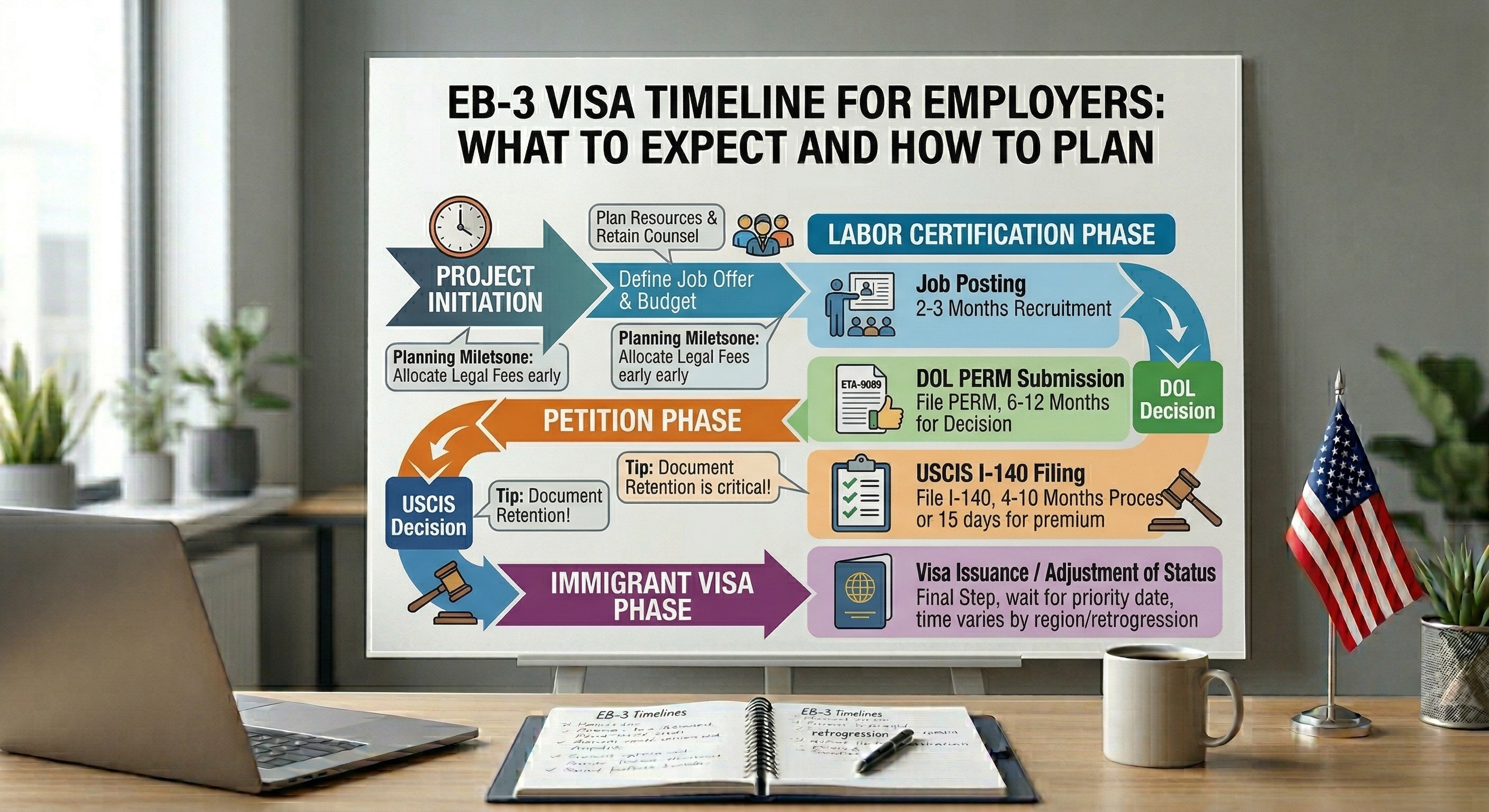
The EB-3 timeline is not fast. For most employers, it takes 2 to 5+ years from start to finish. That's the reality, and if you don't plan for it up front, it becomes a problem later.
This is how the EB-3 timeline works across PERM labor certification, USCIS petition, and consular processing, and where cases run into problems.
How Long Does the EB-3 Process Take for Employers?
PERM Labor Certification — 6 to 18 months
I-140 Petition — 6 to 12 months (15 business days premium)
Visa Availability — Varies by country of birth
Consular Processing — 6 to 12 months
Total Timeline — 2 to 5+ years
The timeline isn't just long, it's variable. Two identical cases can move at completely different speeds depending on audit risk and visa availability.
What Is the EB-3 Visa and Who Qualifies?
The EB-3 is an employment-based immigrant visa in the third preference category. It covers three types of workers: skilled workers in positions requiring at least two years of training or experience, unskilled workers in positions requiring less than two years of training, and professionals with a U.S. bachelor's degree or equivalent.
Unlike the H-2B, which brings workers for a defined temporary period, the EB-3 results in a green card. The worker stays. That's the point, and that's why the process is more involved.
What Is the Step-by-Step EB-3 Process?
Step 1: PERM Labor Certification The first stage of the EB-3 process is PERM Program Electronic Review Management, filed with the Department of Labor. PERM requires the employer to conduct a formal recruitment process to demonstrate that no qualified U.S. workers are available for the position. The recruitment must follow specific DOL requirements: mandatory job postings, defined advertising periods, and documented results.
Once recruitment is complete, the employer files the PERM application. DOL then either certifies, audits, or denies it. Standard processing currently runs 6 to 18 months. An audit adds significant time, sometimes another 12 months or more.
Step 2: I-140 Immigrant Petition: After PERM certification, the employer files the I-140 petition with USCIS to classify the worker under the EB-3 category. Standard processing runs 6 to 12 months. Premium processing is available and reduces USCIS review to 15 business days, worth considering for employers with a specific timeline.
The I-140 establishes the worker's priority date, which determines their place in the visa queue.
Step 3: Visa Availability: This is where the EB-3 timeline becomes unpredictable. This is also where most employer expectations break down. There are a limited number of EB-3 visas available each fiscal year, and demand consistently exceeds supply for workers born in high-demand countries, particularly India, China, Mexico, and the Philippines. Workers from these countries can face waits of several years, sometimes decades, after the I-140 is approved.
Workers born in countries with lower EB-3 demand, including most of Central America, the Caribbean, and parts of Africa, often see much shorter waits, sometimes under a year.
Step 4: Consular Processing or Adjustment of Status: Once a visa number becomes available, the worker either goes through consular processing at a U.S. embassy abroad or adjusts status if already in the U.S. Consular processing typically takes 6 to 12 months from the point the visa becomes available.
What Slows Down the EB-3 Timeline?
PERM audits: DOL audits a significant percentage of PERM applications. An audit requires the employer to submit documentation of the entire recruitment process, every application received, every interview conducted, and every reason a U.S. worker was not hired. Responding to an audit correctly is time-consuming. Responding incorrectly can result in denial.
Recruitment errors: The PERM recruitment process has specific requirements. Advertising must run in the right formats, in the right locations, for the right duration. Errors in recruitment, wrong publication, wrong timeframe, and incomplete documentation require restarting the process.
Inconsistent job descriptions: The job duties described in the PERM application have to match the actual position being filled. If DOL finds that the requirements were written in a way that appears tailored to a specific foreign worker rather than genuinely open to U.S. applicants, the application will be denied.
Priority date backlog: For workers born in backlogged countries, the wait after I-140 approval is outside anyone's control. The Visa Bulletin, published monthly by the State Department, tracks current priority dates. Employers sponsoring workers from India or China need to factor multi-year waits into any workforce planning.
How Visa Availability Affects the EB-3 Timeline
Visa availability is governed by the Visa Bulletin, which moves priority dates forward, and occasionally backward, based on demand. An approved I-140 does not mean a visa is immediately available. It means the worker has a priority date and is waiting for that date to become current.
For workers from most countries, the wait is manageable. For workers from India in the EB-3 category, the backlog is severe, and current wait times run decades in some cases. Employers hiring Indian nationals need to understand this before beginning the process.
The EB-3 unskilled worker subcategory often carries longer waits than the skilled worker subcategory, regardless of country of birth, because both draw from the same annual cap.
When Should an Employer Use EB-3 Instead of H-2B?
These are different tools for different situations. Using the wrong one creates problems.
The H-2B is appropriate when the need is genuinely temporary, a seasonal operation, a peak period, or a defined project. Workers come, the season ends, and they return. The H-2B does not lead to permanent residence and cannot be used as a pathway to a green card.
The EB-3 is appropriate when the employer has a permanent, ongoing need for the position and wants to retain the worker long-term. The position must be full-time and permanent. The employer must be able to demonstrate that it will exist indefinitely.
Employers sometimes consider the EB-3 when H-2B cap issues make seasonal hiring unreliable year over year. That's a legitimate reason to explore it — but the EB-3 requires a multi-year commitment from both the employer and the worker. It's not a workaround for a missed H-2B window. It's a separate, longer, more involved process.
If the need is temporary, use H-2B. If the need is permanent and the employer is committed to retaining the worker, EB-3 is the right path.
Ready to Start an EB-3 Petition?
The EB-3 timeline doesn't shorten once you start. If you're considering it, the only advantage you have is starting earlier than everyone else.
Submit your details below, and we'll map out your exact EB-3 timeline based on your role, country of hire, and start date.
The EB-3 timeline is not fast. For most employers, it takes 2 to 5+ years from start to finish. That's the reality, and if you don't plan for it up front, it becomes a problem later.
This is how the EB-3 timeline works across PERM labor certification, USCIS petition, and consular processing, and where cases run into problems.
How Long Does the EB-3 Process Take for Employers?
PERM Labor Certification — 6 to 18 months
I-140 Petition — 6 to 12 months (15 business days premium)
Visa Availability — Varies by country of birth
Consular Processing — 6 to 12 months
Total Timeline — 2 to 5+ years
The timeline isn't just long, it's variable. Two identical cases can move at completely different speeds depending on audit risk and visa availability.
What Is the EB-3 Visa and Who Qualifies?
The EB-3 is an employment-based immigrant visa in the third preference category. It covers three types of workers: skilled workers in positions requiring at least two years of training or experience, unskilled workers in positions requiring less than two years of training, and professionals with a U.S. bachelor's degree or equivalent.
Unlike the H-2B, which brings workers for a defined temporary period, the EB-3 results in a green card. The worker stays. That's the point, and that's why the process is more involved.
What Is the Step-by-Step EB-3 Process?
Step 1: PERM Labor Certification The first stage of the EB-3 process is PERM Program Electronic Review Management, filed with the Department of Labor. PERM requires the employer to conduct a formal recruitment process to demonstrate that no qualified U.S. workers are available for the position. The recruitment must follow specific DOL requirements: mandatory job postings, defined advertising periods, and documented results.
Once recruitment is complete, the employer files the PERM application. DOL then either certifies, audits, or denies it. Standard processing currently runs 6 to 18 months. An audit adds significant time, sometimes another 12 months or more.
Step 2: I-140 Immigrant Petition: After PERM certification, the employer files the I-140 petition with USCIS to classify the worker under the EB-3 category. Standard processing runs 6 to 12 months. Premium processing is available and reduces USCIS review to 15 business days, worth considering for employers with a specific timeline.
The I-140 establishes the worker's priority date, which determines their place in the visa queue.
Step 3: Visa Availability: This is where the EB-3 timeline becomes unpredictable. This is also where most employer expectations break down. There are a limited number of EB-3 visas available each fiscal year, and demand consistently exceeds supply for workers born in high-demand countries, particularly India, China, Mexico, and the Philippines. Workers from these countries can face waits of several years, sometimes decades, after the I-140 is approved.
Workers born in countries with lower EB-3 demand, including most of Central America, the Caribbean, and parts of Africa, often see much shorter waits, sometimes under a year.
Step 4: Consular Processing or Adjustment of Status: Once a visa number becomes available, the worker either goes through consular processing at a U.S. embassy abroad or adjusts status if already in the U.S. Consular processing typically takes 6 to 12 months from the point the visa becomes available.
What Slows Down the EB-3 Timeline?
PERM audits: DOL audits a significant percentage of PERM applications. An audit requires the employer to submit documentation of the entire recruitment process, every application received, every interview conducted, and every reason a U.S. worker was not hired. Responding to an audit correctly is time-consuming. Responding incorrectly can result in denial.
Recruitment errors: The PERM recruitment process has specific requirements. Advertising must run in the right formats, in the right locations, for the right duration. Errors in recruitment, wrong publication, wrong timeframe, and incomplete documentation require restarting the process.
Inconsistent job descriptions: The job duties described in the PERM application have to match the actual position being filled. If DOL finds that the requirements were written in a way that appears tailored to a specific foreign worker rather than genuinely open to U.S. applicants, the application will be denied.
Priority date backlog: For workers born in backlogged countries, the wait after I-140 approval is outside anyone's control. The Visa Bulletin, published monthly by the State Department, tracks current priority dates. Employers sponsoring workers from India or China need to factor multi-year waits into any workforce planning.
How Visa Availability Affects the EB-3 Timeline
Visa availability is governed by the Visa Bulletin, which moves priority dates forward, and occasionally backward, based on demand. An approved I-140 does not mean a visa is immediately available. It means the worker has a priority date and is waiting for that date to become current.
For workers from most countries, the wait is manageable. For workers from India in the EB-3 category, the backlog is severe, and current wait times run decades in some cases. Employers hiring Indian nationals need to understand this before beginning the process.
The EB-3 unskilled worker subcategory often carries longer waits than the skilled worker subcategory, regardless of country of birth, because both draw from the same annual cap.
When Should an Employer Use EB-3 Instead of H-2B?
These are different tools for different situations. Using the wrong one creates problems.
The H-2B is appropriate when the need is genuinely temporary, a seasonal operation, a peak period, or a defined project. Workers come, the season ends, and they return. The H-2B does not lead to permanent residence and cannot be used as a pathway to a green card.
The EB-3 is appropriate when the employer has a permanent, ongoing need for the position and wants to retain the worker long-term. The position must be full-time and permanent. The employer must be able to demonstrate that it will exist indefinitely.
Employers sometimes consider the EB-3 when H-2B cap issues make seasonal hiring unreliable year over year. That's a legitimate reason to explore it — but the EB-3 requires a multi-year commitment from both the employer and the worker. It's not a workaround for a missed H-2B window. It's a separate, longer, more involved process.
If the need is temporary, use H-2B. If the need is permanent and the employer is committed to retaining the worker, EB-3 is the right path.
Ready to Start an EB-3 Petition?
The EB-3 timeline doesn't shorten once you start. If you're considering it, the only advantage you have is starting earlier than everyone else.
Submit your details below, and we'll map out your exact EB-3 timeline based on your role, country of hire, and start date.
The EB-3 timeline is not fast. For most employers, it takes 2 to 5+ years from start to finish. That's the reality, and if you don't plan for it up front, it becomes a problem later.
This is how the EB-3 timeline works across PERM labor certification, USCIS petition, and consular processing, and where cases run into problems.
How Long Does the EB-3 Process Take for Employers?
PERM Labor Certification — 6 to 18 months
I-140 Petition — 6 to 12 months (15 business days premium)
Visa Availability — Varies by country of birth
Consular Processing — 6 to 12 months
Total Timeline — 2 to 5+ years
The timeline isn't just long, it's variable. Two identical cases can move at completely different speeds depending on audit risk and visa availability.
What Is the EB-3 Visa and Who Qualifies?
The EB-3 is an employment-based immigrant visa in the third preference category. It covers three types of workers: skilled workers in positions requiring at least two years of training or experience, unskilled workers in positions requiring less than two years of training, and professionals with a U.S. bachelor's degree or equivalent.
Unlike the H-2B, which brings workers for a defined temporary period, the EB-3 results in a green card. The worker stays. That's the point, and that's why the process is more involved.
What Is the Step-by-Step EB-3 Process?
Step 1: PERM Labor Certification The first stage of the EB-3 process is PERM Program Electronic Review Management, filed with the Department of Labor. PERM requires the employer to conduct a formal recruitment process to demonstrate that no qualified U.S. workers are available for the position. The recruitment must follow specific DOL requirements: mandatory job postings, defined advertising periods, and documented results.
Once recruitment is complete, the employer files the PERM application. DOL then either certifies, audits, or denies it. Standard processing currently runs 6 to 18 months. An audit adds significant time, sometimes another 12 months or more.
Step 2: I-140 Immigrant Petition: After PERM certification, the employer files the I-140 petition with USCIS to classify the worker under the EB-3 category. Standard processing runs 6 to 12 months. Premium processing is available and reduces USCIS review to 15 business days, worth considering for employers with a specific timeline.
The I-140 establishes the worker's priority date, which determines their place in the visa queue.
Step 3: Visa Availability: This is where the EB-3 timeline becomes unpredictable. This is also where most employer expectations break down. There are a limited number of EB-3 visas available each fiscal year, and demand consistently exceeds supply for workers born in high-demand countries, particularly India, China, Mexico, and the Philippines. Workers from these countries can face waits of several years, sometimes decades, after the I-140 is approved.
Workers born in countries with lower EB-3 demand, including most of Central America, the Caribbean, and parts of Africa, often see much shorter waits, sometimes under a year.
Step 4: Consular Processing or Adjustment of Status: Once a visa number becomes available, the worker either goes through consular processing at a U.S. embassy abroad or adjusts status if already in the U.S. Consular processing typically takes 6 to 12 months from the point the visa becomes available.
What Slows Down the EB-3 Timeline?
PERM audits: DOL audits a significant percentage of PERM applications. An audit requires the employer to submit documentation of the entire recruitment process, every application received, every interview conducted, and every reason a U.S. worker was not hired. Responding to an audit correctly is time-consuming. Responding incorrectly can result in denial.
Recruitment errors: The PERM recruitment process has specific requirements. Advertising must run in the right formats, in the right locations, for the right duration. Errors in recruitment, wrong publication, wrong timeframe, and incomplete documentation require restarting the process.
Inconsistent job descriptions: The job duties described in the PERM application have to match the actual position being filled. If DOL finds that the requirements were written in a way that appears tailored to a specific foreign worker rather than genuinely open to U.S. applicants, the application will be denied.
Priority date backlog: For workers born in backlogged countries, the wait after I-140 approval is outside anyone's control. The Visa Bulletin, published monthly by the State Department, tracks current priority dates. Employers sponsoring workers from India or China need to factor multi-year waits into any workforce planning.
How Visa Availability Affects the EB-3 Timeline
Visa availability is governed by the Visa Bulletin, which moves priority dates forward, and occasionally backward, based on demand. An approved I-140 does not mean a visa is immediately available. It means the worker has a priority date and is waiting for that date to become current.
For workers from most countries, the wait is manageable. For workers from India in the EB-3 category, the backlog is severe, and current wait times run decades in some cases. Employers hiring Indian nationals need to understand this before beginning the process.
The EB-3 unskilled worker subcategory often carries longer waits than the skilled worker subcategory, regardless of country of birth, because both draw from the same annual cap.
When Should an Employer Use EB-3 Instead of H-2B?
These are different tools for different situations. Using the wrong one creates problems.
The H-2B is appropriate when the need is genuinely temporary, a seasonal operation, a peak period, or a defined project. Workers come, the season ends, and they return. The H-2B does not lead to permanent residence and cannot be used as a pathway to a green card.
The EB-3 is appropriate when the employer has a permanent, ongoing need for the position and wants to retain the worker long-term. The position must be full-time and permanent. The employer must be able to demonstrate that it will exist indefinitely.
Employers sometimes consider the EB-3 when H-2B cap issues make seasonal hiring unreliable year over year. That's a legitimate reason to explore it — but the EB-3 requires a multi-year commitment from both the employer and the worker. It's not a workaround for a missed H-2B window. It's a separate, longer, more involved process.
If the need is temporary, use H-2B. If the need is permanent and the employer is committed to retaining the worker, EB-3 is the right path.
Ready to Start an EB-3 Petition?
The EB-3 timeline doesn't shorten once you start. If you're considering it, the only advantage you have is starting earlier than everyone else.
Submit your details below, and we'll map out your exact EB-3 timeline based on your role, country of hire, and start date.

Don't head into winter understaffed. H-2B workers are available if you start now.
Don't head into winter understaffed. H-2B workers are available if you start now.

Explore Our Services




Recruitment Process
Outsourcing (RPO)

Attorney Network
Access
Newsletter
Join Our Newsletter
Get the latest hiring trends, staffing insights, and employer resources, delivered to your inbox.
Don't head into winter understaffed. H-2B workers are available if you start now.